
Why Heart Rate Variability Will Change the Way You Lead Your Team

Ever felt like your brain is a browser with 50 tabs open, and three of them are playing music you can’t find?
That’s the reality of modern leadership. (Hello, 9:00 AM burnout).
We’re told to "be more resilient" or "just manage your stress," but let’s be honest: willpower isn’t a strategy.
If you want to lead a high-performing team without losing your mind, you need to look at what’s happening under the hood.
Specifically, your Heart Rate Variability (HRV).
It sounds technical, but it’s actually the most powerful "biological dashboard" you have for leadership.
What is Heart Rate Variability (and why should you care)?
Forget what you know about a steady pulse.
A healthy heart doesn’t beat like a metronome; it’s actually quite "messy."
HRV is the tiny fluctuation in time between each consecutive heartbeat.
If your heart beats at 60 beats per minute, it’s not actually beating once every second.
It might be 0.9 seconds, then 1.1 seconds, then 1.05 seconds.
→ High variability (a "messy" rhythm) = A flexible, resilient nervous system.
→ Low variability (a "robotic" rhythm) = A stressed, brittle nervous system.
Think of it like a rubber band. A high HRV means you’re flexible and can bounce back. A low HRV means you’re stretched to the limit and ready to snap. (Because stress is unavoidable, but snapping is optional).
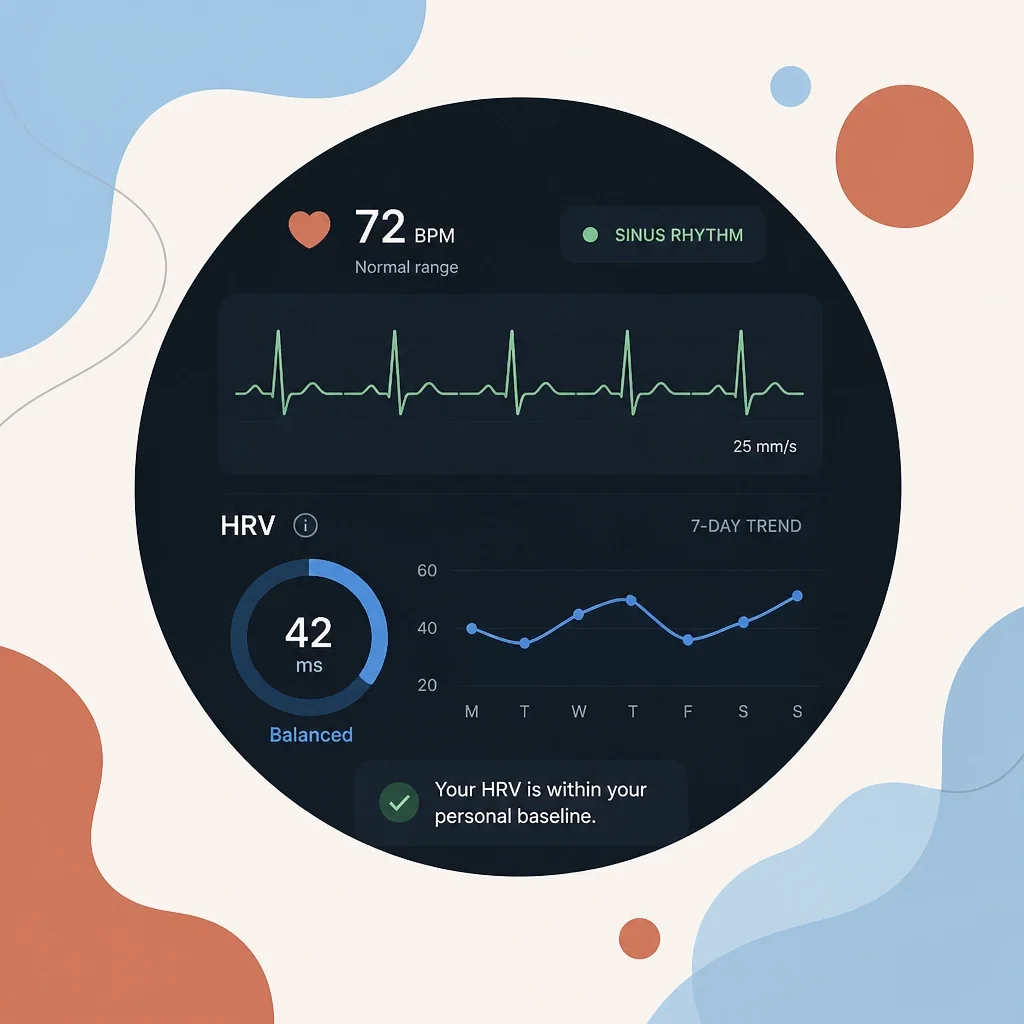
The Science: Why the best leaders are "Heart-Centred"
We’re big on evidence here at InnerWorkings.
We don't just guess; we look at the data.
Recent research by Alacreu-Crespo (2022) found that leaders with an "intuitive" decision-making style actually show higher high-frequency HRV.
Basically, being in tune with your physiology makes you better at making the right calls under pressure.
Other key studies show:
Performance Under Pressure: Vanuk (2019) demonstrated that the ability to modulate your HRV is a direct predictor of how well you’ll perform during a stressful task.
Brain Power: Forte (2021) highlights that higher HRV is linked to better executive function. That’s the part of your brain responsible for planning, focusing, and ignoring distractions.
In short? HRV is a physiological marker of your ability to handle the "heat" of leadership.
Leadership is an Emotional Sport
You might think leadership is all about logic and spreadsheets.
But your team is reacting to your nervous system before you even open your mouth.
When your HRV is low, your body is stuck in "fight or flight" mode.
This makes you:
Less empathetic.
More prone to snap judgments.
Less likely to see the "big picture."
Low HRV → High Stress → Poor Emotional Intelligence → Team Disconnection.
When you invest in heart rate variability training, you aren't just improving your health.
You’re upgrading your leadership operating system.

How HRV Prevents the "Quiet Quit"
We talk a lot about employee burnout prevention, but it starts at the top.
If a leader is burnt out, the team follows. (It's contagious, unfortunately).
By using nervous system regulation techniques, you can keep your HRV in a healthy range, even when the quarterly reports look a bit shaky.
This creates a "calm ripple effect" across your organization.
When you are regulated, your team feels safe.
When your team feels safe, they innovate, collaborate, and actually enjoy their jobs. (Imagine that!).
Practical Steps to Boost Your HRV (The InnerWorkings Way)
At InnerWorkings, we specialize in translating this complex science into actionable programs that fit into your busy workday.
You don't need a meditation retreat to fix your HRV.
Here’s how we start:
Personalised Breathwork: Certain breathing patterns (like resonant frequency breathing) can "hack" your vagus nerve and boost HRV in minutes.
Workplace Stress Management Strategies: It's about micro-interventions. A 2-minute desk-based movement can shift your nervous system from "panic" to "performance."
Vagal Toning: Using science-backed exercises to strengthen your body's "brake pedal" for stress.
Our programs are designed to align with the NSW Work Health and Safety Regulation 2025 and the NSW Code of Practice for Managing Psychosocial Hazards. As of July 1, 2026, this Code becomes a mandatory compliance benchmark in NSW. InnerWorkings helps your business stay ahead of these requirements by integrating both individual nervous system regulation and organizational work-design strategies, supporting the 'Hierarchy of Controls' mandated by SafeWork NSW and Safe Work Australia.

Ready to lead with more focus and less fatigue?
Leading a team in 2026 is hard enough.
Don't let a brittle nervous system make it harder.
Whether you're looking to reduce absenteeism or just want a team that isn't running on fumes, focusing on HRV is the smartest move you can make.
Want to see how we can bring these science-backed shifts to your team?
We’d love to chat about your workplace. No high-pressure sales, just a conversation about how to make your team (and your heart) more resilient.
Let’s get those "tabs" under control.
Daniella & The InnerWorkings Team